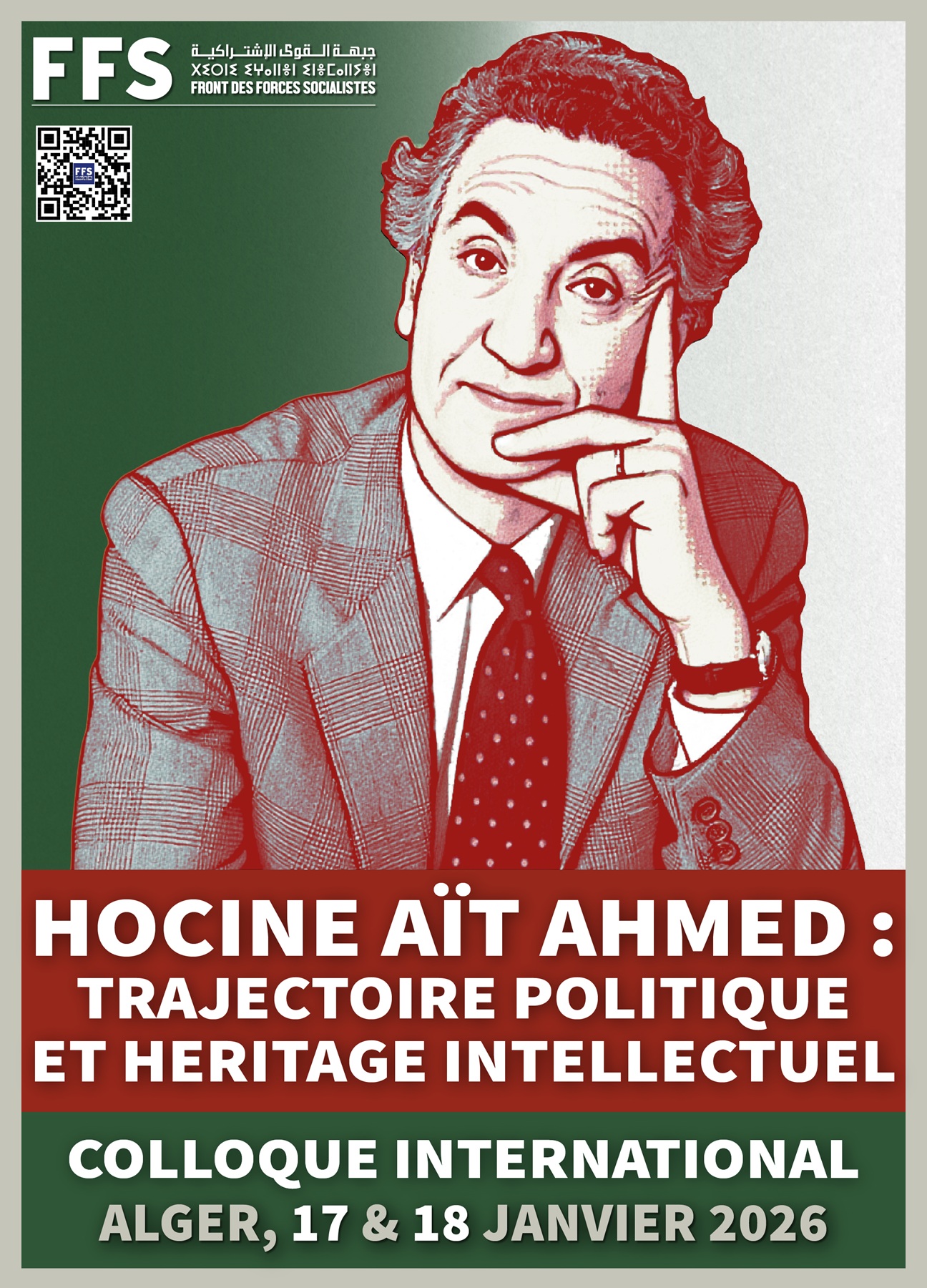
Colloque International
Hocine Aït Ahmed : trajectoire d’un combat politique et héritage d’une œuvre intellectuelle (1926-2026)
Alger, 17 et 18 janvier 2026
École supérieure d’hôtellerie et restauration d’Alger (ESHRA)
Route Nationale 11, Aïn Benian
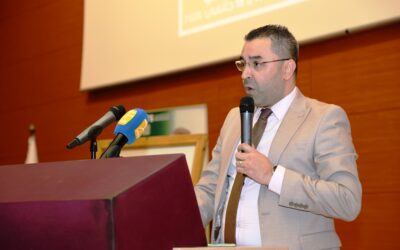
Mot de clôture du colloque sur l’héritage de Hocine Aït Ahmed
Mot de clôture du Premier Secrétaire national du FFS du Colloque international sur la trajectoire politique et l’héritage intellectuel de Hocine Aït Ahmed . Mesdames et Messieurs, Chers invités, chers chercheurs et universitaires, Chers camarades, Au terme de ces deux...
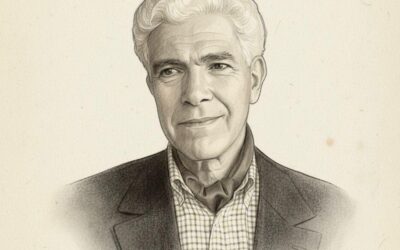
Colloque International Hocine Aït Ahmed : Hommage à Mohammed Harbi
Hommage à Mohammed Harbi (1933–2026) : L’exigence de vérité du militant, du témoin et de l’historien Par Samir Ghezlaoui Coordinateur du colloque Mesdames et Messieurs, Chers collègues, Chers amis de la presse, Chers camarades, Nous sommes réunis aujourd’hui, en ce...

Message de la famille Mécili au Colloque international Hocine Aït Ahmed
Je suis très émue d’être avec vous aujourd’hui pour rendre hommage à Hocine Aït Ahmed. Pour moi et pour mon frère c’était Tonton Hocine qui a continué de veiller sur nous après la mort de notre père, André Ali Mécili. Je pense qu’on ne peut pas rendre hommage à Hocine...
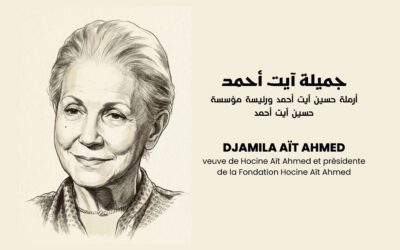
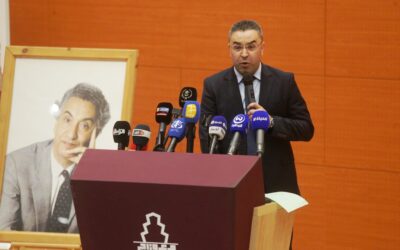
Allocution d’ouverture du colloque international sur la trajectoire politique et l’héritage intellectuel de Hocine Aït Ahmed
Alger, le 17 janvier 2026. Mesdames et Messieurs, Chers historiens, chercheurs et universitaires, algériens et étrangers, Chers amis de la presse, Chers camarades, Honorable assistance, Salam, Azul, Votre présence aujourd’hui, si nombreuse et prestigieuse, honore ce...
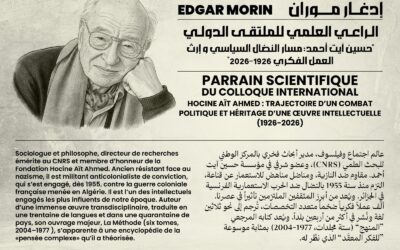
Edgar Morin : Parrain scientifique du colloque international
تتشرف جبهةُ القوى الاشتراكية (الأفافاس) بأن تُعلن أنّ الراعي العلمي للملتقى الدولي «حسين آيت أحمد: مسارُ النضال السياسيّ وإرثُ العملٍ الفكريّ (1926–2026)» هو عالمُ الاجتماع والفيلسوف إدغار موران، العضوُ الشرفيّ في مؤسسة حسين آيت أحمد. Le Front des forces socialistes...
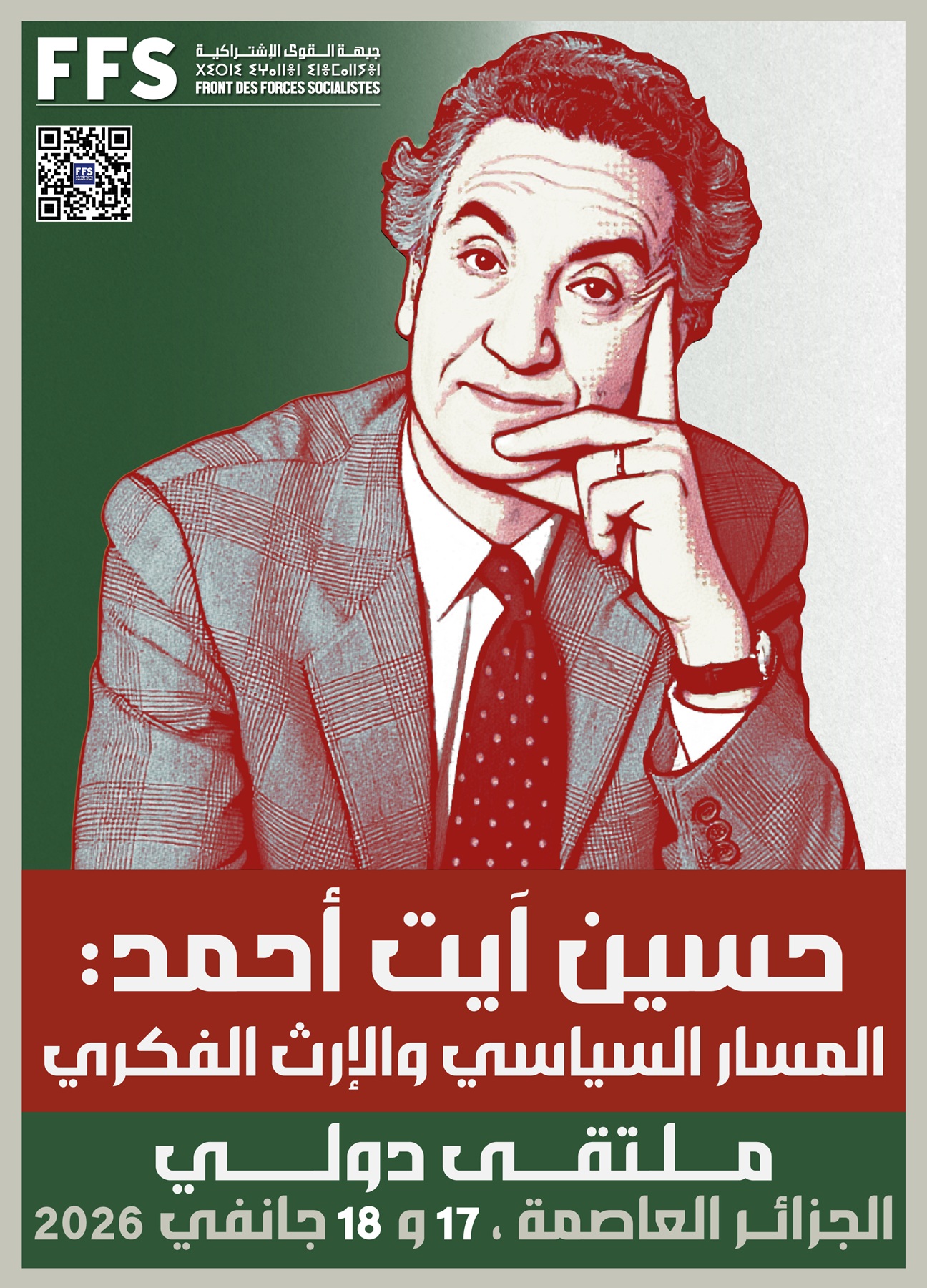
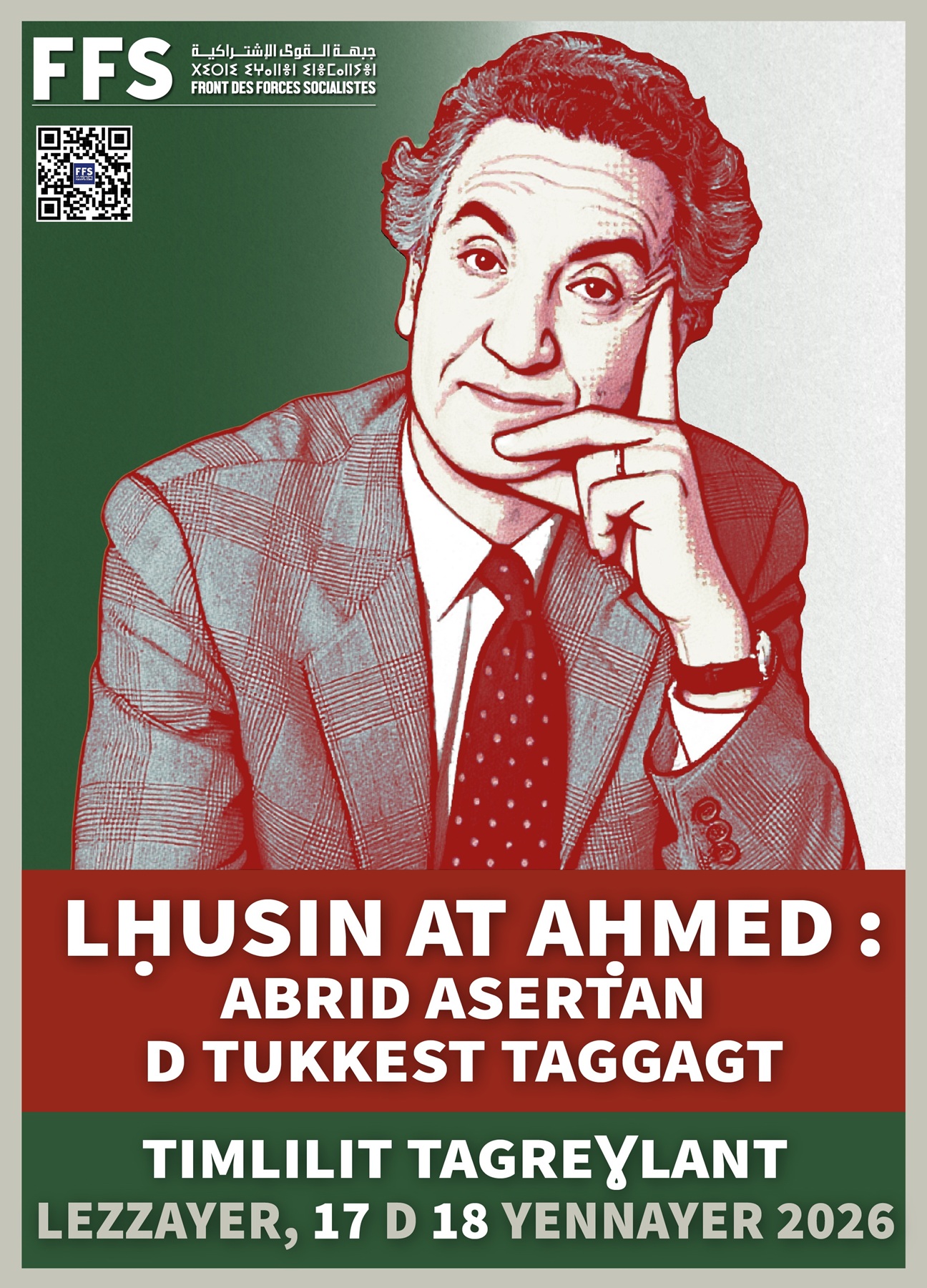
Programme
SAMEDI 17 JANVIER 2026 | Session d’ouverture - السبت 17 يناير2026 | الجلسة الافتتاحية
08:30 – استقبال الجمهور و المشاركين
09:30 – مراسم الافتتاح
10:00 – المحاضرة الافتتاحية:
مصطفى بن جعفر، رئيس شرفي للأممية الاشتراكية، مؤسّس حزب التكتل وأمينها العام السابق ، و الرئيس السابق للمجلس الوطني التأسيسي التونسي.
« حسين آيت أحمد: مناضل، دبلوماسي، و مرافع عن الديمقراطية »
10:30 – استراحة
———————
08h30 – Accueil du public et des participants
09h30 – Cérémonie d’ouverture
10h00 – Conférence inaugurale : Mustapha Ben Jaâfar, président d’honneur de l’Internationale socialiste, fondateur et ancien Secrétaire général d’Ettakatol, ex-président de l’Assemblée constituante tunisienne
Hocine Aït Ahmed : Résistant, Diplomate et Promoteur de la Démocratie
10h30 – Pause café
SESSION #1 الجلسة رقم
بروز شخصية تاريخية قيادية خلال الحركة الوطنية
تأطير الجلسة: سمير غزلاوي، جامعي و صحفي
11:00 – محمد لحسن زغيدي، مؤرخ
طفولة و شباب حسين آيت أحمد: جذور الوعي السياسي لثائر جزائري.
11:25 – بنجامين ستورا، مؤرخ
دور آيت أحمد في بروز جيل شاب وطني راديكالي بعد مجازر 8 ماي 1945
11:50 – عمار محند عامر، مؤرخ
الفكر الثوري لدى حسين آيت أحمد: من المنظمة الخاصة (OS) إلى تقرير زدين
12:15 – أسئلة من داخل القاعة
13:00 – استراحة
14:00 – علي قنون، مؤرخ
حسين آيت أحمد و الأزمة الديمقراطية داخل الحركة الوطنية 1949: المواقف والانعكاسات
14:25 – وناسة سياري تنقور، مؤرخة
حسين آيت أحمد: تجربة رجل في خدمة التاريخ
14:50 – فؤاد سوفي، مؤرخ
ما تكشفه صورة من تاريخنا: حسين آيت أحمد في السردية الوطنية
15:15 – مصطفى بوشاشي، محامي ومناضل حقوقي
حسين آيت أحمد، قائد في الحركة الوطنية ورائد النضال من أجل حقوق الإنسان في الجزائر
15:40 – أسئلة من داخل القاعة ونقاش ختامي
————————
ÉMERGENCE D’UN LEADER HISTORIQUE DU MOUVEMENT NATIONAL
Modération : Samir Ghezlaoui, universitaire et journaliste
11h00 – Mohamed Lahcen Zeghidi, historien
Enfance et jeunesse de Hocine Aït Ahmed : aux origines de la conscience politique d’un révolutionnaire algérien
11h25 – Benjamin Stora, historien
Rôle d’Aït Ahmed dans l’émergence d’une jeune génération nationaliste radicale après les massacres du 8 mai 1945
11h50 – Amar Mohand-Amer, historien
Pensée révolutionnaire de Hocine Aït Ahmed : de l’Organisation spéciale (OS) au rapport de Zeddine
12h15 – Questions de la salle
13h00 – Pause déjeuner
14h00 – Ali Guenoun, historien
Hocine Aït Ahmed et la crise démocratique de 1949 au sein du mouvement national : positions et conséquences
14h25 – Ouanassa Siari Tengour, historienne
Hocine Aït Ahmed : l’expérience d’un homme au service de l’histoire
14h50 – Fouad Soufi, historien
Ce que révèle une photographie de notre histoire : Hocine Aït Ahmed dans le récit national
15h15 – Mostefa Bouchachi, avocat et militant des droits humains
Hocine Aït Ahmed, leader du mouvement national et précurseur du combat pour les droits de l’Homme en Algérie
15h40 – Questions de la salle et discussion finale
Baptisation du siège national du FFS au nom de Hocine Aït Ahmed - تسمية المقرّ الوطني لجبهة القوى الاشتراكية باسم حسين آيت أحمد
17:00 – مراسم تسمية مقرّ جبهة القوى الاشتراكية، الكائن بـ 56 شارع سويداني بوجمعة، المرادية، الجزائر
——————–
17h00 – Cérémonie de baptisation du siège du FFS, sis au 56 avenue Souidani Boudjemaa, El Mouradia, Alger
DIMANCHE 18 JANVIER 2026 - الأحد 18 جانفي 2026
09:00 – استقبال الجمهور والمشاركين
——————–
09h00 – Accueil du public et des participants
SESSION #2 الجلسة رقم
من الكفاح ضد الاستعمار إلى النضال الديمقراطي
إدارة الجلسة: رشيد حمّودي، جامعي
10:00 – جيل مانسرون، مؤرخ
النشاط السياسي والدبلوماسي لحسين آيت أحمد من أجل تدويل القضية الجزائرية
10:25 – عيسى قادري، باحث في علم الاجتماع
المنبع الفكري لحسين آيت أحمد: التزام مناهض للاستعمار في إطار بعده المغاربي
10:50 – إسماعيل تاحي، مؤرخ وأستاذ جامعي
مواقف ومساهمات حسين آيت أحمد خلال فترة سجنه: من الصومام إلى اتفاقيات إيفيان، مرورًا بتأسيس الحكومة المؤقتة
11:15 – أسئلة من داخل القاعة
11:45 – استراحة
12:00 – ميلندا سريج، طالبة دكتوراه في التاريخ
تأسيس جبهة القوى الاشتراكية: بداية النضال السياسي ما بعد الاستقلال لدى حسين آيت أحمد
12:25 – جمال بالول، أستاذ جامعي و برلماني سابق عن جبهة القوى الاشتراكية
حسين آيت أحمد: مسار نضال ديمقراطي من أجل السلم المدني والمصالحة والتوافق الوطني (1965–2013)
12:50 – أسئلة من داخل القاعة
13:10 – نقاش ختامي
13:30 – استراحة
——————–
DE LA LUTTE ANTICOLONIALE AU COMBAT DEMOCRATIQUE
Modération : Rachid Hammoudi, universitaire
10h00 – Gilles Manceron, historien
Action politique et diplomatique de Hocine Aït Ahmed pour l’internationalisation de la cause algérienne
10h25 – Aissa Kadri, sociologue
Matrice intellectuelle de Hocine Aït Ahmed : un engagement anticolonial dans sa dimension maghrébine
10h50 – Smail Tahi, historien et enseignant universitaire
Positions et contributions de Hocine Aït Ahmed durant son emprisonnement : de la Soummam aux accords d’Évian, en passant par la création du GPRA
11h15 – Questions de la salle
11h45 – Pause café
12h00 – Mélinda Seridj, doctorante en histoire
Création du Front de forces socialistes (FFS) : genèse de l’engagement politique postcolonial de Hocine Aït Ahmed
12h25 – Djamel Baloul, enseignant universitaire et ancien député du FFS
Hocine Aït Ahmed : le parcours d’un combat démocratique pour la paix civile, la réconciliation et le consensus national (1965–2013)
12h50 – Questions de la salle
13h10 – Discussion finale et débat avec la salle
13h30 – Pause déjeuner
SESSION #3 الجلسة رقم
مثقف في خدمة الحريات و التعدديات
إدارة الجلسة: ميلندا سريج، طالبة دكتوراه في التاريخ
14:30 – تسعديت ياسين، باحثة في الأنتروبولوجيا
حسين آيت أحمد و بناء الشخصية الجزائرية
14:55 – إبراهيم تازغارت، كاتب ومناضل سابق في الحركة الثقافية الأمازيغية
الهوية في فكر وممارسة حسين آيت أحمد
15:20 – نجيب سيدي موسى، باحث في العلوم السياسية
إعادة قراءة كتاب “الأفروفاشية” لحسين آيت أحمد: تنظير للحريات و لحقوق الشعوب الإفريقية
15:45 – سليمان بن عيسى، كاتب مسرحي وروائي وممثل
مكانة التعددية الثقافية في حياة حسين آيت أحمد
16:10 – نقاش و أسئلة من داخل القاعة
————————-
UN INTELLECTUEL AU SERVICE DES LIBERTES ET DES PLURALISMES
Modération : Mélinda Seridj, doctorante en histoire
14h30 – Tassadit Yacine, anthropologue
Hocine Aït Ahmed et la construction de la personnalité algérienne
14h55 – Brahim Tazaghart, écrivain et ancien militant du MCB
L’identité dans la pensée et l’action de Hocine Aït Ahmed
15h20 – Nedjib Sidi Moussa, politologue
Relire l’Afro-fascisme de Hocine Aït Ahmed : penser les libertés et les droits des peuples africains
15h45 – Slimane Benaïssa, dramaturge, romancier et acteur
La place du pluralisme culturel dans la vie de Hocine Aït Ahmed
16h10 – Discussion finale et débat avec la salle
CONFERENCE DE CLOTURE - المحاضرة الختامية
17:00 – مصطفى البرغوثي، طبيب و أمين عام المبادرة الوطنية الفلسطينية
حسين آيت أحمد: مسار ينير درب نضال الشعوب المقهورة من أجل تقرير مصيرها
17h00 – Mustafa Barghouthi, médecin et secrétaire général de l’Initiative nationale palestinienne
Hocine Aït Ahmed, une trajectoire qui éclaire le combat des peuples opprimés pour leur autodétermination
ملتقى دولي
حسين آيت أحمد: مسار النضال السياسي و إرث العمل الفكري (1926-2026)
الجزائر العاصمة – 17 و18 جانفي 2026
1. السياق والإشكالية العامة:
بعد قرن من ميلاد حسين آيت أحمد وعشر سنوات على رحيله، تقف الجزائر مرة أخرى أمام عمليات إعادة تشكيل عميقة ذات طابع سياسي و اجتماعي و ثقافي. تندرج هذه التغييرات ضمن سياق دولي و إقليمي يتسم بتحولات غير مسبوقة منذ نهاية الحرب الباردة، لا سيما فيما يتعلق بعودة الديناميكيات الإمبريالية والنيو كولينيالية التي تقودها القوى الكبرى. أما على الصعيد الداخلي، فإن المطالب المستمرة بإرساء دولة قانون حقيقية، وتعددية ديمقراطية فعلية، وعدالة اجتماعية، وازدهار اقتصادي، لا تزال تؤطر الفضاء العام و توجه تطلعات المواطنين، في مجتمع جزائري أصبح مندمجاً بالكامل مع التدفقات و الترابطات والإكراهات التي تفرضها العولمة.
على الرغم من غيابه الجسدي، لا تزال شخصية آيت أحمد الفكرية تحتل مكانة متفردة جداً في المشهد الاجتماعي والسياسي و خلال الذاكرة الوطنية. فقد كان قائداً ثورياً سبّاقا في صفوف حزب الشعب الجزائري-حركة انتصار الحريات الديمقراطية (PPA-MTLD)، ومهندس المنظمة الخاصة (OS)، وفاعلاً رئيساً لحظة إعلان بيان أول نوفمبر 1954، و الدبلوماسي الأول للثورة الجزائرية. كما كان أيضاً أحد رواد المعارضة الديمقراطية: مؤسس جبهة القوى الاشتراكية (FFS) عام 1963، وأحد أكثر المنظرين الجزائريين تأثيراً في قضايا السيادة الشعبية، والحريات العامة، ودولة القانون. وقد وجدت أفكاره ورؤاه صدىً واضحاً خلال الحركات الشعبية الكبرى التي ميزت التاريخ الحديث للبلاد، من الاستقلال في 5 جويلية 1962 وصولاً إلى الحراك الشعبي في 22 فيفري 2019.
إن الشدّ القائم بين دور آيت أحمد كثوري وأحد « الآباء المؤسسين » للجزائر المستقلة – وهي صفة تم الاعتراف بها ومأسستها تدريجياً من قبل الدولة – وبين مساره كمعارض عنيد لا يلين – ضد دكتاتورية الحزب الواحد بدايةً، ثم ضد مختلف النزعات الاستبدادية الأصولية والبوليسية في التسعينيات – يشكل رهاناً هاما لعلم الاجتماع السياسي وللتأريخ المعاصر. لهذا السبب، يطمح هذا الملتقى الدولي المخصص له إلى تجاوز الطابع الإحيائي البحت، لاستحضار مسار الرجل من جديد، والتزاماته المتعددة، والأثر المستدام لنضاله السياسي والفكري والأخلاقي.
2. محطات أساسية من حياة الرجل و آثاره:
ولد حسين آيت أحمد في 20 أوت 1926، بعين الحمام (ميشلي سابقاً)، بولاية تيزي وزو. تشكّل وعيه في وقت مبكر جداً وتشبع بالثقافة القروية القبائلية، والقيم الريفيّة، اذ رفض الهيمنة الاستعمارية رغم انتمائه إلى عائلة مرابطية ميسورة الحال. ينحدر من جهة والدته من سلالة الشيخ محند أوالحسين، الشاعر الشعبي الشهير وأحد المرشدين الروحيين للطريقة الرحمانية. انضم إلى حزب الشعب الجزائري عام 1942 وهو لا يزال تلميذاً في ثانوية بن عكنون بالجزائر العاصمة، وسرعان ما اندمج في الهيئات القيادية للحركة الوطنية.
غداة مجازر 8 ماي 1945، برزت قيادته وسط النخبة الشابة والمثقفة والراديكالية في حزب الشعب-حركة الانتصار، التي كانت مقتنعة بضرورة القطيعة الاستراتيجية مع العمل السياسي القانوني واختيار الكفاح المسلح ضد الاستعمار الفرنسي. وفي مؤتمر الحزب عام 1947، دفع باتجاه إنشاء المنظمة الخاصة (OS)، وهي هيكل شبه عسكري سري، تولى قيادته في نهاية العام نفسه. وفي ديسمبر 1948، حرر وقدم « تقرير زدين »، الذي حدد الأبعاد السياسية، والهوياتية، والمالية، والدبلوماسية للثورة الجزائرية المقبلة. وكضحية جانبية للأزمة المعروفة بـ « الأزمة البربرية » عام 1949، تم إبعاده من على رأس المنظمة الخاصة وتهميشه كليا من طرف قيادة الحزب حتى نهاية عام 1951، وهي الفترة التي ظل فيها دون أي مسؤولية نضالية.
بينما استغل هذه الفترة لتأسيس عائلة، واصل في ذات الوقت تعميق تفكيره السياسي حول الثورة، التي لم يكن يتصورها من الزاوية العسكرية فحسب، بل من المنظور الدبلوماسي أيضاً. سنة 1952، أُرسل للانضمام إلى الوفد الخارجي في القاهرة، حيث وضع أسس الدبلوماسية الثورية الجزائرية. وبعد الأزمة الداخلية لحزب الشعب-حركة الانتصار عام 1953 بين المصاليين والمركزيين، دعم ظهور « طرف ثالث »، تجسد في مطلع عام 1954 بإنشاء اللجنة الثورية للوحدة والعمل (CRUA)، بهدف التحضير لتفجير حرب التحرير الوطنية، التي اندلعت فعلا في الأول من نوفمبر 1954 بقيادة جبهة التحرير الوطني (FLN) وجيش التحرير الوطني (ALN)، وهما منظمتان قادتهما مجموعة « التسعة التاريخيين »، ومن بينهم آيت أحمد.
بصفته المسؤول الأول على الدبلوماسية الجزائرية الناشئة، سرّع عملية تدويل قضية الاستقلال من خلال تحقيق عدة إنجازات تاريخية: المشاركة في مؤتمري راندون (1953) وباندونغ (1955)؛ وتحقيق انتصارين حاسمين في الأمم المتحدة، وهما إدراج القضية الجزائرية في جدول أعمال الجمعية العامة في سبتمبر 1955، ثم فتح مكتب لوفد جبهة التحرير الوطني في نيويورك في أفريل 1956. ورغم اعتقاله وسجنه مع رفاقه الأربعة (بن بلة، بوضياف، خيضر، و لشرف) إثر قرصنة طائرتهم من قبل المخابرات الفرنسية في 22 أكتوبر 1956، حافظ آيت أحمد على قدرته في التأثير على الخيارات الاستراتيجية للثورة من داخل زنزانته، لا سيما من خلال دعم قرارات مؤتمر الصومام، واقتراح إنشاء الحكومة المؤقتة للجمهورية الجزائرية (GPRA)، والدفاع عن خيار المفاوضات التي أدت إلى اتفاقيات إيفيان، والتي اعتبرها السبيل الضامن للاستقلال والوحدة الترابية في مواجهة مخاطر مخططات التقسيم الاستعمارية.
فور خروجه من السجن، وقف آيت أحمد ضد الصراع على السلطة بين مختلف الأطراف المتنازعة، وعارض لاحقاً بشكل مباشر مصادرة السلطة من قبل تحالف بن بلة-بومدين خلال صيف 1962. وفي 29 سبتمبر 1963، محاطاً ببعض الإطارات العليا للثورة، أسس جبهة القوى الاشتراكية (FFS)، متمسكاً بمبادئ أول نوفمبر 1954 وأرضية الصومام لـ 20 أوت 1956. بين سبتمبر 1963 وجوان 1965، قاد الحزب مقاومة سياسية وعسكرية ضد السلطة المركزية، وهي فترة كانت مؤلمة للغاية للمؤسس، حيث قُتل أكثر من 400 مناضل من حزبه في مواجهات مع الجيش النظامي، بينما تعرض هو نفسه للقمع والاعتقال والحكم بالإعدام الذي ألغي لاحقاً.
فرّ آيت أحمد من السجن عام 1966 باتجاه المنفى، في سويسرا. وهناك دشن مرحلة جديدة في حياته الطويلة كمناضل سياسي ومثقف ثائر، ملتزم بالدفاع عن حقوق الإنسان والديمقراطية، في الجزائر كما في العالم الذي كان يعيش انعكاسات ما بعد الاستعمار . استأنف دراسته وحصل على ليسانس في الحقوق من جامعة لوزان (سويسرا) ودكتوراه من جامعة نانسي (فرنسا)، حول موضوع « حقوق الإنسان بين الميثاق و الممارسة في منظمة الوحدة الإفريقية » (1975). وبالموازاة، ظل المحرّك الرئيسي للمعارضة الجزائرية، مكثفاً المبادرات لتوحيد مختلف مكوناتها، مع التنديد بالانحرافات الاستبدادية للحزب الواحد.
تدخل، بالكلمة والفعل، في العديد من المحطات المفصلية التي عاشتها الجزائر قبل وبعد التعددية. حيث لعب دوراً أساسياً، بشكل مباشر أو غير مباشر، في: الربيع الأمازيغي في 20 أفريل 1980، الذي قادته على نحو واسع إطارات جبهة القوى الاشتراكية في السرية؛ مؤتمر لندن في 16 ديسمبر 1985، الذي أعدّه ذراعه الأيمن، المحامي علي مسيلي (الذي اغتيل في 7 أفريل 1987 من طرف المخابرات العسكرية)؛ أحداث 5 أكتوبر 1988، حيث انحاز للمتظاهرين الشباب ودعا السلطات للتخلي عن القمع؛ التعبئة ضد توقيف المسار الانتخابي في 11 جانفي 1992، الذي وصفه بـ « الانقلاب »؛ مؤتمر سانت إيجيديو (عقد روما) في 13 جانفي 1995، وهي مبادرة لإيجاد مخرج سلمي من الأزمة، اجتمع خلاله بصفته رئيسا للأفافاس مع مسؤولي تنظيمات سياسية ومدنية جزائرية أخرى.
توفي حسين آيت أحمد في 23 ديسمبر 2015، ودفن، وفقاً لوصيته، في مسقط رأسه بقرية آيت أحمد (آيت يحيى) في 1 جانفي 2016، وسط موكب شعبي مهيب ضم قرابة مليون شخص. شهد هذا الحضور الهائل على حجم التقدير الذي يكنّه له جزء كبير من الشعب الجزائري، المدرك لإرثه السياسي و الفكري وحتى الأدبي. فعلى مدار سبعين عاماً من الالتزام، أنتج عشرات التقارير والمذكرات والمقالات. كما أنه ألف كتبا لاقت نجاحاً كبيراً: الحرب وما بعد الحرب (1964)؛ الفاشية الإفريقية (1980)؛ مذكرات مكافح: روح الاستقلال 1942-1952 (1983)؛ قضية مسيلي (1989). ولا يزال الكثيرون يأملون في نشر نصوصه غير المنشورة بعد وفاته من قبل مؤسسة حسين آيت أحمد.
3. الأهداف العلمية للملتقى
يندرج هذا الملتقى الدولي في إطار نقاش وتبادل أكاديمي وعلمي يهدف إلى استكشاف الأبعاد والجوانب المختلفة لأعمال حسين آيت أحمد:
– إعادة قراءة مساره بشكل نقدي: من خلال الربط بين السيرة السياسية، تاريخ المؤسسات، سوسيولوجيا الحركات الاجتماعية وتحليل الأفكار العقائدية؛
– مساءلة انسجام واستمرارية وتحولات مواقفه: من سرية المنظمة الخاصة وصولاً إلى مقترحات الانتقال الديمقراطي في التسعينيات والألفينيات؛
– تحليل بناء شخصيته: في الذاكرة النضالية، السرديات السياسية، وسائل الإعلام، البحث الأكاديمي وسياسات الاعتراف المؤسساتي؛
– تسليط الضوء على البعد الدولي لعمله الدبلوماسي والفكري: في الفضاءات الأفرو-آسيوية، المغاربية، الأوروبية والأممية.
– مناقشة راهنية فكره: في ظل النضالات المعاصرة في الجزائر وعبر العالم (السيادة الشعبية، التعددية، حقوق الإنسان، مسألة الهويات، إدارة النزاعات والمصالحات، تقرير مصير الشعوب، إلخ).
وفي هذا السياق، ستوجّه بعض الأسئلة المحورية مجمل النقاشات :
– ما الذي يعلّمنا مسار حسين آيت أحمد حول التجاذبات بين الثورة والدولة والجيش والديمقراطية في تاريخ الجزائر المعاصرة؟
– كيف يمكن التفكير معاً في دوره كفاعل في حرب التحرير وكمعارض للأنظمة المنبثقة عن هذا الكفاح نفسه؟
– كيف تتردد أصداء أفكاره حول الهوية الجزائرية، المسألة الأمازيغية، التعددية اللغوية والثقافية مع النقاشات الحالية؟
– كيف يمكن لمواقفه الفكرية بشأن العنف السياسي، الحرب الأهلية، المصالحة، دولة القانون وحقوق الإنسان أن تضيء المسارات ما بعد الاستبدادية والحركات الشعبية الأخيرة، لا سيما الحراك؟
4. إطار التنظيم ونشر مضمون المداخلات
يتوجه هذا الملتقى الدولي إلى جمهور متنوع من الجامعيين (باحثين، أساتذة وطلبة) وإلى كل المواطنين بشكل عام. ستجري الأشغال بعدة لغات (العربية، الأمازيغية، الفرنسية والإنجليزية)، مع توفير خدمة الترجمة الفورية. سيتم إصدار مؤلف جماعي في أقرب الآجال، يضم جميع المداخلات المقدمة ومختارات من النقاشات التي ميزت مختلف الجلسات.
————————————
ANAMAL AGRAƔLAN LHUSIN AT ḤMED
ABRID N UMENNUƔ ASERTAN D TGEMMI N UNEḌRU AMESNALLAN (1926-2026)
Lezzayer – 17 & 18 Yennayer 2026.
1-Asatal d tamukerist tamatut
Asatal d tmukrist tamatut Asmi yella-d lqern ɣef tlalit n Lḥusin At Ḥmed d mraw n iseggasen ɣef tmettant-is, Lezzayer tqubel tilaliyin timaynutin tisertanin, tinmettiyin d tidelsanin tilqaɛinin. Tignatin-a ḍrant-d deg usatal agraɣlan adigan yeččuren d ibeddilen imeqranen ur nelli ara seg taggara n Ṭrad asemmaḍ, ladɣa ɣef wayen yeεnan tuɣalin n temharsa tamaynut i d-ttawint tizemmar timeqranin.
Ɣef weswir adigan , asuter d-yettuɣalen d win icudden ɣere ddula n lḥeqq, d tugdut taḥeqqanit, d teɣdemt tanmettit akk d rrbeḥ adamsan, mazal-iten sudusen idigan n izuyaz , deg yiwet n tmetti tazzayrit ikecmen deg kra n yemdewṛen , timaniyin d wuguren d-yexdem tallit tatrart.
Ɣas akken ulac-it gar-aneɣ, tugna n Lhusin At Ḥmed yezga yeṭṭef amḍiq-is weḥd-s deg umezruy d tmetti tazzayrit akk d waktay aɣelnaw . D amwenneɣ n zik deg PPA-MTLD, d netta I yesbedden Tuddsa tusligt (OS), d argaz n umennuɣ n 1 n wumbir 1954, d adiblumasi amezwaru n Tagrawla tazzayrit, yella daɣen d amezwaru n uɣunzu agdudan: d amesnulfa n Tirni n Yiɣallen Inemlayen (FFS) deg 1963, yerna d yiwen seg yimyura izzayriyen i d-yefkan tiktiwin ɣef tanaya taɣerfant, tilelliyin tizuyaz d ddula n lḥeqq.
Axemmem -ines d tiktiwin-ines ufant tiɣri tameqrant deg yimussuyen iɣerfanen i d-yebbin abrid n umezruy n tmurt, seg timmunent n 5 Yulyu 1962 alamma d LḤirak n 22 Furar 2019.
Amgarad yellan si tama n Lḥusin At Ḥmed agrawliw, akk d « yiwen ger ibabaten» n lezzayer tilelli – d taɣra yellan deg usteɛṛef n ddula- , si tama nniḍen akken i yella d yiwen d-yefɣen mgal akabar awḥid yerna ur yekni,
ɣef ayagi agraw-agi agraɣlan yettwaxedmen fella-s, ur yettili ara d alug kan n usfugel , maca ad yili d abrid d-yebbi d umennuɣ yexdem, d wayen akk yexdem di tilawt.
2- Imniren n tudert d tukkest
Ilul ass n 20 Ɣuct 1926 deg At Yaḥya ( di Micli), deg ugezdu n Tizi- Wezzu, Lhusin At Ḥmed yekker-d s tɣerma n taddart d wazalen n yifellaḥen d uɣunzu n temharsa tafransist, ɣas akken d mmi-s n twacult n yimerabḍen yesɛan cwiṭ n ttawil. Seg yimawlan n yemma-s, d mmi-s n mmi-s n Ccix Muḥend U Lhusin, amedyaz ameqran d ccix n ṭṭariqa Teṛḥmanit. Yekcem ɣer PPA deg 1942, asmi yella d anelmad deg tesnawit n Ben Aknoun, deg Lezzayer, anda yekcem ɣer tqacuct n umussu aɣelnaw. Deffir n tmenɣiwt n 8 May 1945, banen-d d izamulen gar yilmeẓyen n PPA-MTLD, i yumnen s webrid n uḥebbus n tsertit n lkaɣeḍ , ṣwab-is d abrid n ubecciḍ mgal Fransa. Deg wegraw n ukabar n 1947, d netta i d-yefkan afud i usnulfu n OS, tuddsa tusgilt, i ɣef yella ɣef uqerruy-is deg taggara n useggas-nni. Deg Duǧember 1948, yura « Ṛabun n Zeddine », anda i d-yefka iferdisen isertanen, n tnekkit, n yedrimen d tdiblumasit n Tagrawla tazzayrit. Ɣef sebba n « Tazɣent tabeṛbaṛit » n 1949, ssufɣen-t seg tnella n ukabar alamma d taggara n 1951.imiren ur yesɛi ara kra n tmasit tasertant , ifaṛes tagnitt akken ad yexdem axxam , , ikemmel axemmem asertan ɣef tagrawla, mačči kan s wudem n ubecciḍ, maca ula s wudem n tdiblumasit. Aɛzal-is yekfa deg 1952 asmi i t-ceggɛen ɣer tesmilt n beṛṛa ɣer Qahira, anda i d-yessers lsas n tdiblumasit tagrawliwt. Deffir n tezɣent n PPA-MTLD n 1953, yefka afud i webrid adiblumasi . di tazɣent nni n CRUA deg 1954, iwakken ad heyyin i ṭrad n uslelli aɣelnaw.anda mqabalen imesaliyen akk d ilemmasen ,netta yedda d webrid wis krad , anda d-iban di tazwara n 1954 asbeddi n anbaz agrawliw n tdukli d yirmad ( CRUA) , anda yeswâ iswi d aheggi n tegrawla i weslelli aɣelnaw , ad tili ass n umenzu n wunbir 1954 , s yisem n tirni n uslelli aqêlnaw ( F L N ) yellan d tuddsa qêf uqeṛṛuy-is tza iɣella n tegrawla , anda yella Si Lḥusin At Ḥmed.
Am uqerruy n tdiblumasit tazzayrit, yexdem aṭas iwakken ad d-yawi lbaḍna i temsalt tazzayrit: amtig deg temlilit n Rangoon (1953) d Bandung (1955); d rrbeḥ ameqran deg Tuddsa n tmura Yedduklen (ONU), asmi i d-ssekcmen tamsalt tazzayrit ɣer wummuɣ n wahil n useqqamu deg Ctember 1955, d tullya n lbiru n FLN deg New York deg Yebrir 1956.
At Ḥmed ikemmel yettmuddu-d tiktiwin-is seg lḥebs, ladɣa aserḥeb s yigemmaḍ n Wegraw n Sumam, d usnulfu n GPRA d weqbal n Umtawa n Ebian.
Mi d-yeffeɣ seg lḥebs, At Ḥmed ibedd mgal imenɣi ɣef leḥkem gar yizrumen (Lezzayer-Tlemsan-Tizi -Wezzu), d wamek i fkan leḥkem i Ben Bella d Bumedyen deg unebdu n 1962. Ass n 29 Cutembeṛ1963, yesnulfa-d Tirni n Yiɣallen Inemlayen (FFS), ɣef lsas n tiktiwin n 1 wunbir 1954 d tiɣerɣert n Ṣumam n 20 Ɣuct 1956. Ger Cutembeṛ 1963 d Yunyu 1965, FFS yexdem amennuɣ asertan d umennuɣ s leslaḥ mgal udabu, d tallit i weɛren aṭas ɣef At Ḥmed imi ugar n 400 n yimeɣnasen n ukabar-is mmuten, netta s yiman-is ḥebsen-t yerna ḥekmen fell-as s lmut. At Ḥmed yerwel seg lḥebs deg 1966 ɣer lɣerba. Deg tmurt n Suisse, yebda tudert tamaynut n umennuɣ asertan d umesnalla , yettnaɣ ɣef yizerfan n wemdan d tugdut, deg Lezzayer d umaḍal. Yebbi-d agerdas-is “Licence” n lqanun deg Tesdawit n Lausanne d Doctorat deg Tesdawit n Nancy (Fransa) ɣef « Izerfan n wemdan deg Tuddsa n Tdukli Tafriqit (OUA) » (1975). Deg wayen yerzan tasertit, yeqqim d aqerruy n uɣunzu (opposition) tazzayrit. Yekki, s wawal d tigawt, deg waṭas n tignatin timeqranin: Tafsut Imaziɣen (1980), Timlilit n London (1985) akk d Me Ali Mecili (i yettwanɣan deg 1987), amussu n 5 Tuber 1988, amennuɣ mgal uḥebbus n lbuṭ n 11 Yennayer 1992 iwumi isemma « Coup d’État », d Temlilit n Sant’Egidio (Lɛaqd n Roma) deg 1995 iwakken ad d-afen tifrat i tezɣent tazzaurit . Yemmut ass n 23 Duǧember 2015, yenṭel di taddart-is At Ḥmed (Ayt Yeḥya) ass n 1 Yennayer 2016, s tilin n ugar n umelyun n yemdanen. Ttbut-a ameqran yesbeyyin-d azal i s-yefka weɣref azzayri. Yura aṭas n yedlisen: La Guerre et l’après-guerre (1964), L’Afro-fascisme (1980), Mémoires d’un combattant (1983), L’Affaire Mécili (1989). Aṭas i yettraǧun ad d-ffɣen yidlisen-is nniḍen seg « Tneggit Hocine Aït Ahmed ».
3-Iswiyen ussnan n unamal
Anamal-agi agraɣlan , ad yili di tzelɣa n ubeddel n tiktiwin d leṛyuy akadimiyen usnan yemxallafen, iwakken ad d-nawi ɣef yiswiren yemgaraden n uneḍru n Lhusin At Ḥmed: Aεawed n tmeẓri i webrid-is:
– Aseqreb n tbiugrafit tasertant, amazray n tneggwa, tasnmetti n yimussuyen inmettiyen d tesleḍt n tiktiwin.
– Asteqsi ɣef temtelkit d ubeddel n umuɣen-is: Seg userfer n OS ɣer yisutren n ucebbel agdudan n yiseggasen 1990-2000.
– Tasleḍt n usebded n tugna-s: Deg yiktayen n yimeɣnasen, inzan isertanen, tiɣimsit, d unadi usnan.
-Askan deg annar tigawt-is tadiblumasit d tmesnallant: Deg tallunt tafṛu-asyawit, tamaɣṛabit, turubbit d tunusit (ONU).
– Asteqsi ɣef wazal n tiktiwin-is ass-a: Imennuɣen n tura deg Lezzayer d umaḍal (tannaya taɣerfant, tagget, izerfan n wemdan, tamsalt n tnekkit, tifrat n yimennuɣen, azref n yigduden, atg.).
Deg ubrid-a, kra n yisteqsiyen ad ilin d lsas n umbadal:
D acu i aɣ-d-teselmad tmeẓri n Lhusin At Ḥmed ɣef umgired gar Tagrawla, Ddula, Lɛeskeṛ d Tugdut deg Lezzayer tatrart?
Amek ara nesseddu irmad-is am n umennuɣ n uslelli d yirmad-is am uɣunzu-ines mgal yinagrawen i d-yeffɣen seg umennuɣ-agi?
Amek ttembiwilent tiktiwin-is ɣef tnekkit tazzayrit, tamsalt n tummast tamaziɣt, tagget tameslayt d tdelsant ɣer yiskasiyen n tura?
Amek ara d-fɣent tiktiwin-is ɣef teṛyeẓ tasertant, ṭrad n daxel, taɣdemt, ddula n lḥeqq d yizerfan n wemdan tafat i yimussuyen iɣerfanen imaynuten, ladɣa Ḥirak?
4-Tazelɣa n tuddsa d usufeɣ n igiten
Anamal-a agraɣlan yeldi i yizuyaz si yal aswir, i yisdawanen (iselmaden, inelmaden akk d yimnadiyen) d weɣref s umata. Lecɣal akk n unamal ad ilin s waṭas n tutlayin (Taɛrabt, Tamaziɣt, Tafransist d Teglizit),s ttawil n tsuqilt taɣawalt. Ad d-yeffeɣ wedlis yedduklen deffir n unamal, ad ttwajemɛent akk tiktiwin d yiskasiyen yellan di tedwilin yemxallafen.
————————————
Colloque International
Hocine Aït Ahmed : trajectoire d’un combat politique et héritage d’une œuvre intellectuelle (1926-2026)
Alger – 17 & 18 janvier 2026
1. Contexte et problématique générale
Un siècle après la naissance de Hocine Aït Ahmed et dix ans après sa disparition, l’Algérie se trouve de nouveau confrontée à de profondes recompositions politiques, sociales et culturelles. Celles-ci s’inscrivent dans un contexte international et régional caractérisé par des mutations d’une ampleur inédite depuis la fin de la guerre froide, notamment en matière de résurgences de dynamiques impérialistes et néocoloniales portées par les grande puissances. Sur le plan interne, les revendications persistantes d’un véritable État de droit, d’un pluralisme démocratique effectif, de justice sociale et de prospérité économique continuent de structurer l’espace public et d’orienter les attentes citoyennes, dans une société algérienne désormais pleinement insérée dans les circulations, les interdépendances et les contraintes imposées par la mondialisation en réseaux.
Quoique physiquement absent, la figure d’Aït Ahmed occupe toujours une place très singulière dans le paysage socio-politique et mémoriel national. Leader révolutionnaire précoce au sein du PPA-MTLD (Parti du peuple algérien-Mouvement pour le triomphe des libertés démocratiques), artisan de l’Organisation spéciale (OS), acteur de premier plan au moment de la Proclamation du 1er novembre 1954 et premier diplomate de la Révolution algérienne, il fut également l’un des pionniers de l’opposition démocratique : fondateur, dès 1963, du Front des Forces Socialistes (FFS) et l’un des théoriciens algériens les plus influents de la souveraineté populaire, des libertés publiques et de l’État de droit. Sa pensée et ses idées ont trouvé une résonance manifeste durant les principaux mouvements populaires qui ont jalonné l’histoire récente du pays, depuis l’indépendance du 5 juillet 1962 jusqu’au Hirak du 22 février 2019.
La tension entre, d’une part, le rôle d’Aït Ahmed en tant que révolutionnaire et l’un des « pères fondateurs » de l’Algérie indépendante – qualité progressivement reconnue et institutionnalisée par l’État – et, d’autre part, son parcours de dissident irréductible – d’abord face à la dictature du parti unique, ensuite contre les diverses tentations autoritaires intégristes et policières des années 1990 – constitue un enjeu majeur pour la sociologie politique et pour l’historiographie contemporaine. C’est pourquoi ce colloque international, qui lui est consacré, ambitionne de dépasser le simple registre commémoratif pour interroger, à nouveaux frais, la trajectoire de l’homme, la pluralité de ses engagements et la portée durable de son œuvre politique, intellectuelle et morale.
2. Repères de vie et d’œuvre
Né le 20 août 1926 à Aïn El Hammam (ex-Michelet), dans l’actuelle wilaya de Tizi Ouzou, Hocine Aït Ahmed est très tôt façonné par la culture villageoise kabyle, les valeurs paysannes et le refus de la domination coloniale, en dépit de son appartenance à une famille maraboutique aisée. Par sa lignée maternelle, il est en effet descendant de Cheikh Mohand Oulhoucine, célèbre poète populaire et l’un des guides spirituels de la confrérie Rahmaniyya. Il rejoint le PPA en 1942, alors qu’il est encore élève au lycée de Ben Aknoun, à Alger, où il intègre rapidement les instances dirigeantes du mouvement national.
Au lendemain des Massacres du 8 mai 1945, son leadership émerge parmi la jeune garde intellectuelle et radicale du PPA-MTLD, convaincue de la nécessité d’une rupture stratégique avec l’action politique légaliste et d’opter pour la lutte armée contre la colonisation française. Au congrès du parti de 1947, il impulse la création de l’OS, structure paramilitaire clandestine, dont il prend la direction à la fin de la même année. En décembre 1948, il rédige et présente le Rapport de Zeddine, définissant les dimensions politiques, identitaires, financières et diplomatiques de la future Révolution algérienne. Dommage collatéral de la crise dite « berbériste » de 1949, le chef national de l’OS est mis à l’écart par la direction du parti jusqu’à la fin de l’année 1951, période durant laquelle il est sans aucune responsabilité militante.
Tout en profitant de cette parenthèse pour fonder une famille, il poursuit et approfondit sa réflexion politique autour de la révolution, envisagée non pas exclusivement sous l’angle militaire, mais aussi à travers le prisme diplomatique. Sa marginalisation prend fin en 1952 lorsqu’il est envoyé rejoindre la délégation extérieure au Caire, où il jette les bases d’une diplomatie révolutionnaire algérienne. Après la crise interne du PPA-MTLD de 1953, opposant messalistes et centralistes, il soutient l’émergence d’une troisième voie, qui se concrétise début 1954 par la création du Comité révolutionnaire d’unité et d’action (CRUA), avec pour objectif de préparer le déclenchement de la guerre de libération nationale. Celle-ci est engagée le 1er novembre 1954 par le Front de libération nationale (FLN) et l’Armée de libération nationale (ALN), organisations dirigées par le groupe des « neuf historiques », dont Aït Ahmed.
En tant que chef de la diplomatie algérienne naissante, il accélère le processus d’internationalisation de la cause indépendantiste en lui assurant plusieurs exploits historiques : participation aux conférences de Rangoun (1953) et de Bandung (1955) ; obtention de deux victoires déterminantes à l’Organisation des Nations unies (ONU), en l’occurrence l’inscription de la question algérienne à l’ordre du jour de l’Assemblée générale, en septembre 1955, puis l’ouverture d’un bureau de la délégation du FLN à New York, en avril 1956. Arrêté et emprisonné, avec quatre de ses camarades (Ben Bella, Boudiaf, Khider et Lacheraf), à la suite du détournement de leur avion par les services français, le 22 octobre 1956, Aït Ahmed garde néanmoins sa capacité à influer sur les choix stratégiques de la Révolution depuis sa cellule, notamment en soutenant les résolutions du Congrès de la Soummam, en proposant la création du GPRA et en défendant l’option des négociations qui conduiront aux accords d’Évian, qu’il considère comme la voie garantissant l’indépendance et l’intégrité territoriale face aux risques des plans coloniaux de partition.
Dès sa sortie de prison, Aït Ahmed s’élève contre la lutte pour le pouvoir entre les différents clans (Alger-Tlemcen-Tizi Ouzou) et, par la suite, s’oppose frontalement à la confiscation du pouvoir par le tandem Ben Bella-Boumédiène durant l’été 1962. Le 29 septembre 1963, entouré de quelques hauts cadres de la Révolution, il fonde le Front des Forces Socialistes (FFS), se réclamant des principes du 1er Novembre 1954 et de la plateforme de la Soummam du 20 août 1956. Entre septembre 1963 et juin 1965, le FFS mène une résistance à la fois politique et militaire contre le pouvoir central, une période particulièrement douloureuse pour le fondateur car plus de 400 militants de son parti sont tués lors d’affrontements avec l’armée régulière et subissant lui-même répression, arrestation et condamnation à mort commuée.
Aït Ahmed s’évade de prison en 1966 et part en exil. Installé en Suisse, il ouvre une nouvelle phase dans sa longue vie de militant politique et d’intellectuel révolté, engagé en faveur de la défense des droits humains et de la démocratie, en Algérie comme dans l’ensemble du monde postcolonial. Dans cet esprit, il reprend ses études et obtient une licence de droit à l’Université de Lausanne et un doctorat à l’Université de Nancy (France) portant sur « Les droits de l’homme dans la charte et la pratique de l’Organisation de l’unité africaine (OUA) » (1975). Parallèlement, il demeure le principal animateur de l’opposition algérienne en multipliant les initiatives pour fédérer ses diverses composantes, tout en dénonçant les dérives autoritaires du parti unique.
Il intervient, par la parole et par l’action, dans de nombreux moments clés vécus par l’Algérie avant et après l’ère multipartite. Il joue ainsi un rôle essentiel, direct ou indirect, dans : le Printemps berbère du 20 avril 1980, mené en grande partie par les cadres du FFS clandestin ; la Conférence de Londres du 16 décembre 1985, préparée par son bras droit Me Ali Mécili, assassiné le 7 avril 1987 par la sécurité militaire ; les Événements du 5 octobre 1988, séquence au cours de laquelle il prend le parti des jeunes manifestants et appelle les autorités à renoncer à la répression ; les mobilisations contre l’arrêt du processus électoral du 11 janvier 1992, qu’il qualifie de « coup d’État » ; la Conférence de Sant’Egidio (Contrat de Rome) du 13 janvier 1995, initiative de sortie de crise pacifique qui a réuni le leader du FFS et les responsables d’autres organisations politiques et citoyennes algériennes ; etc.
Décédé le 23 décembre 2015, Hocine Aït Ahmed est inhumé, conformément à son souhait testamentaire, dans son village natal d’Aït Ahmed (Aït Yahia), le 1er janvier 2016, accompagné par un cortège populaire de près d’un million de personnes. Cette immense affluence témoigne de l’ampleur de la reconnaissance que lui accorde une large partie du peuple algérien, sensible à ses héritages politiques et intellectuels voire littéraires. Tout au long de soixante-dix années d’engagement, il a en effet produit des dizaines de rapports, de mémorandums et d’articles. De même, il est l’auteur de livres à grand succès : La Guerre et l’après-guerre (Éditions de Minuit, 1964) ; L’Afro-fascisme (L’Harmattan, 1980) ; Mémoires d’un combattant. L’esprit d’indépendance, 1942-1952 (Messinger, 1983) ; L’Affaire Mécili (La Découverte, 1989). Beaucoup sont ceux qui espèrent encore la publication, à titre posthume, de ses textes inédits par la Fondation Hocine Aït Ahmed.
3. Objectifs scientifiques du colloque
Ce colloque international s’inscrira dans un cadre d’un débat et d’échanges académiques et scientifiques visant à explorer les différentes dimensions et facettes de l’œuvre de Hocine Aït Ahmed :
– Revisiter de manière critique son parcours : en articulant biographie politique, histoire des institutions, sociologie des mouvements sociaux et analyse des idées doctrinales ;
– Interroger la cohérence, la continuité et les inflexions de ses positions : depuis la clandestinité de l’OS jusqu’aux propositions de transition démocratique des années 1990-2000 ;
– Analyser la construction de sa figure : dans les mémoires militantes, les récits politiques, les médias, la recherche académique et les politiques de reconnaissance institutionnelle ;
– Mettre en lumière la portée internationale de son action diplomatique et intellectuelle : dans les espaces afro-asiatique, maghrébin, européen et onusien ;
– Discuter l’actualité de sa pensée : luttes contemporaines en Algérie et à travers le monde ailleurs (souveraineté populaire, pluralisme, droits humains, question des identités, gestion des conflits et des réconciliations, auto-détermination des peuples, etc.).
Dans ce sillage, quelques questions transversales guideront les échanges:
– Que nous apprend la trajectoire de Hocine Aït Ahmed sur les tensions entre révolution, État, armée et démocratie dans l’histoire de l’Algérie contemporaine ?
– Comment penser ensemble son rôle d’acteur de la lutte de libération et celui d’opposant face aux régimes issus de cette même lutte ?
De quelles manières ses idées sur l’identité algérienne, la question berbère, le pluralisme linguistique et culturel résonnent-elles avec les débats actuels ?
– Comment ses positions intellectuelles sur la violence politique, la guerre civile, la réconciliation, l’État de droit et les droits de l’Homme peuvent-elles éclairer les trajectoires post-autoritaires et les mouvements populaires récents, notamment le Hirak ?
4. Cadre de l’organisation et publication des actes
Ce colloque s’adresse à un public diversifié d’universitaires (chercheurs, enseignants et étudiants) et au grand public. Les travaux du colloque se dérouleront en plusieurs langues (arabe, tamazight, français et anglais), avec un dispositif de traduction simultanée. Une publication collective est envisagée à l’issue du colloque, sous forme d’un ouvrage collectif réunissant toutes les communications présentées et une sélection des discussions ayant marqué les différentes sessions.
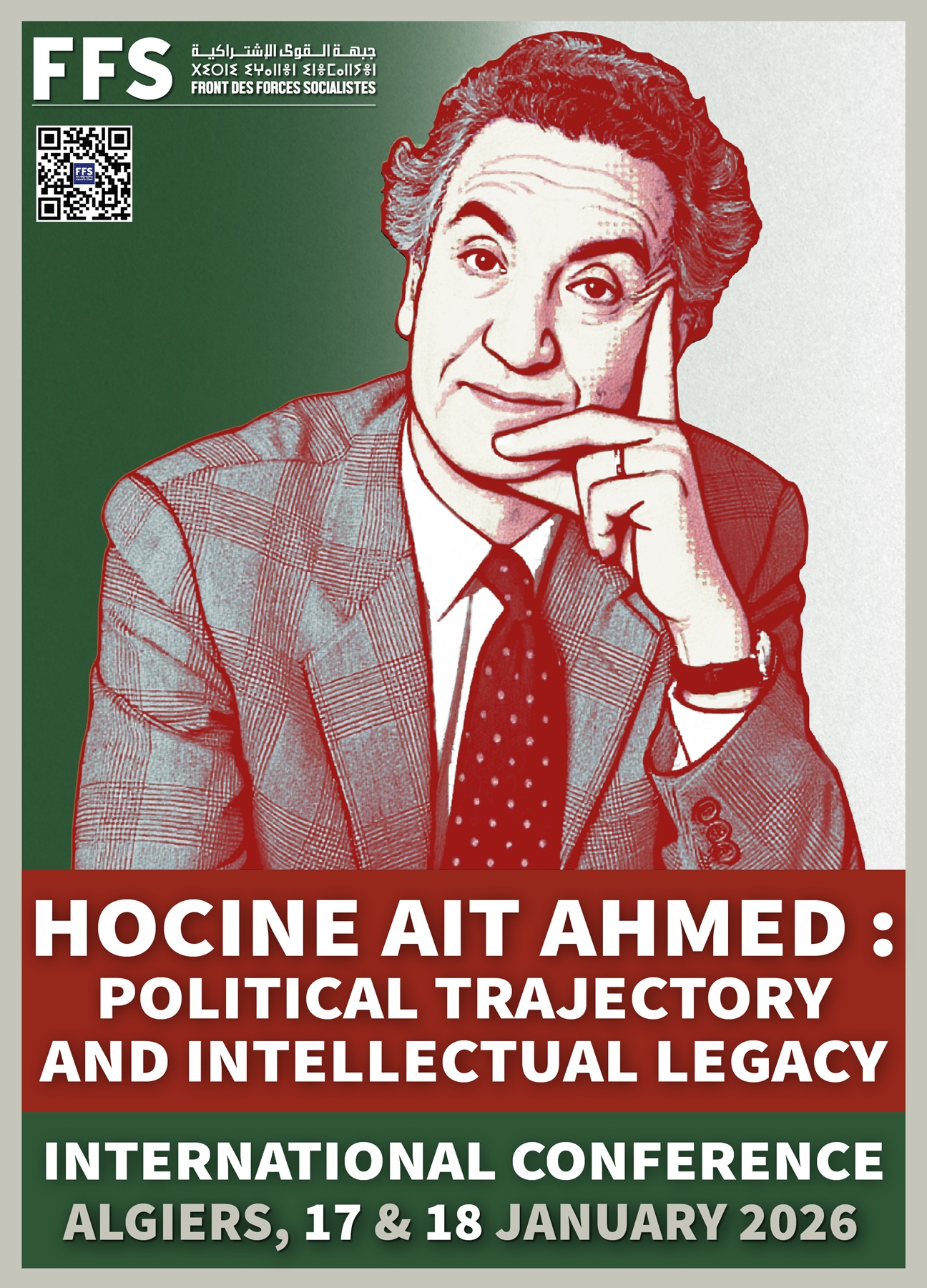
International Conference
Hocine Aït Ahmed : Trajectory of a political struggle and legacy of an intellectual work (1926-2026)
Algiers – January 17 & 18, 2026
1. Context and General Framework
A century after the birth of Hocine Aït Ahmed and ten years after his passing, Algeria once again faces profound political, social, and cultural recompositions. These are taking place within an international and regional context characterized by changes of an unprecedented magnitude since the end of the Cold War, particularly regarding the resurgence of imperialist and neocolonial dynamicsdriven by major powers. Internally, persistent demands for a genuine rule of law, effective democratic pluralism, social justice, and economicprosperity continue to structure the public sphereand guide citizen expectations. This occurs withinan Algerian society now fully integrated into the flows, interdependencies, and constraints imposedby networked globalization.
Although physically absent, the figure of Aït Ahmed still occupies a very singular place in the national socio-political and memorial landscape. A precocious revolutionary leader within the PPA-MTLD (Parti du peuple algérien-Mouvement pour le triomphe des libertés démocratiques), architect of the Special Organization (OS), a leading figure during the Proclamation of November 1, 1954, and the first diplomat of the Algerian Revolution, he wasalso a pioneer of the democratic opposition. He founded the Socialist Forces Front (FFS) in 1963 and was one of the most influential Algerian theorists on popular sovereignty, public liberties, and the rule of law. His thoughts and ideas foundmanifest resonance during the major popularmovements that have marked the country’s recenthistory, from independence on July 5, 1962, to the Hirak of February 22, 2019.
The tension between, on one hand, Aït Ahmed’srole as a revolutionary and one of the « foundingfathers » of independent Algeria —a statusprogressively recognized and institutionalized by the State— and, on the other hand, his path as an unwavering dissident —first against the single-party dictatorship, then against the various fundamentalistand police-state authoritarian temptations of the 1990s— constitutes a major issue for politicalsociology and contemporary historiography. Therefore, this international colloquium dedicated to him aims to move beyond simple commemoration to interrogate, with a fresh perspective, the man’s trajectory, the plurality of his commitments, and the enduring scope of his political, intellectual, and moral work.
2. Biographical and Intellectual Milestones
Born on August 20, 1926, in Aïn El Hammam (formerly Michelet) in the current Wilaya of Tizi Ouzou, Hocine Aït Ahmed was shaped early on by Kabyle village culture, peasant values, and the refusal of colonial domination, despite belonging to a well-to-do maraboutic family. Through hismaternal line, he was a descendant of Cheikh Mohand Oulhoucine, a famous popular poet and spiritual guide of the Rahmaniyya brotherhood. He joined the PPA in 1942 while still a student at the Ben Aknoun high school in Algiers, where he quicklyintegrated into the leadership bodies of the national movement.
In the aftermath of the Massacres of May 8, 1945, his leadership emerged among the youngintellectual and radical guard of the PPA-MTLD, whowere convinced of the need for a strategic break with legalist political action in favor of armedstruggle against French colonization. At the party congress of 1947, he drove the creation of the OS, a clandestine paramilitary structure, taking over itsleadership at the end of that year. In December 1948, he drafted and presented the Zeddine Report, defining the political, identity-based, financial, and diplomatic dimensions of the future Algerian Revolution. As collateral damage of the so-called »Berberist » crisis of 1949, the national chief of the OS was sidelined by the party leadership until the end of 1951, a period during which he held no militant responsibilities.
While using this interlude to start a family, hecontinued and deepened his political reflection on revolution, viewed not exclusively through a militaryangle but also through a diplomatic prism. Hismarginalization ended in 1952 when he was sent to join the external delegation in Cairo, where he laid the foundations for Algerian revolutionarydiplomacy. Following the internal PPA-MTLD crisisof 1953 between Messalists and Centralists, hesupported the emergence of a « third way. » This materialized in early 1954 with the creation of the Revolutionary Committee of Unity and Action (CRUA), aimed at preparing the outbreak of the warof national liberation. The war was launched on November 1, 1954, by the National Liberation Front (FLN) and the National Liberation Army (ALN), organizations led by the group of the « historic nine, » including Aït Ahmed.
As the head of nascent Algerian diplomacy, heaccelerated the internationalization of the independence cause, securing several historicachievements: participation in the Rangoon (1953) and Bandung (1955) conferences; and obtainingtwo decisive victories at the United Nations (UN)—specifically, the inclusion of the Algerian question on the General Assembly agenda in September 1955, followed by the opening of an FLN delegation office in New York in April 1956. Arrested and imprisonedwith four comrades (Ben Bella, Boudiaf, Khider, and Lacheraf) following the hijacking of their plane by French services on October 22, 1956, Aït Ahmed nevertheless maintained his ability to influence the strategic choices of the Revolution from his cell. Notably, he supported the resolutions of the Soummam Congress, proposed the creation of the GPRA (Provisional Government of the Algerian Republic), and defended the option of negotiationsleading to the Évian Accords, which he viewed as the path guaranteeing independence and territorial integrity against colonial partition plans.
Upon his release from prison, Aït Ahmed spoke out against the power struggle between different clans (Algiers-Tlemcen-Tizi Ouzou) and subsequentlyopposed the confiscation of power by the Ben Bella-Boumédiène alliance during the summer of 1962. On September 29, 1963, surrounded by high-ranking cadres of the Revolution, he founded the Socialist Forces Front (FFS), claiming adherence to the principles of November 1, 1954, and the Soummam platform of August 20, 1956. Between September 1963 and June 1965, the FFS led a resistance that was both political and military against the central power, a particularly painfulperiod for the founder as more than 400 party militants were killed in clashes with the regular army, while he himself suffered repression, arrest, and a death sentence that was later commuted.
Aït Ahmed escaped from prison in 1966 and wentinto exile. Settling in Switzerland, he opened a new phase in his long life as a political militant and rebellious intellectual, committed to defendinghuman rights and democracy in Algeria and throughout the postcolonial world. In this spirit, heresumed his studies, obtaining a law degree fromthe University of Lausanne and a doctorate from the University of Nancy (France) with a thesis on « Human Rights in the Charter and Practice of the Organization of African Unity (OAU) » (1975). Simultaneously, he remained the principal animatorof the Algerian opposition, multiplying initiatives to federate its various components while denouncingthe authoritarian drifts of the single party.
He intervened, through both words and action, in numerous key moments experienced by Algeria before and after the multiparty era. He played an essential role, direct or indirect, in: the Berber Spring of April 20, 1980, led largely by clandestine FFS cadres; the London Conference of December 16, 1985, prepared by his right-hand man Ali Mécili (assassinated on April 7, 1987, by military security); the events of October 5, 1988, where he sided withyoung demonstrators and called on authorities to renounce repression; the mobilizations against the halting of the electoral process on January 11, 1992, which he qualified as a « coup d’état »; and the Sant’Egidio Conference (Rome Platform) of January 13, 1995, a peaceful crisis-resolution initiative thatbrought together the FFS leader and heads of otherAlgerian political and civic organizations.
Passing away on December 23, 2015, Hocine Aït Ahmed was buried, in accordance with histestamentary wish, in his native village of Aït Ahmed (Aït Yahia) on January 1, 2016, accompanied by a popular procession of nearly one million people. This immense turnout testifies to the scope of recognition granted to him by a large part of the Algerian people, who remain sensitive to hispolitical, intellectual, and even literary legacies. Throughout seventy years of engagement, heproduced dozens of reports, memorandums, and articles. He is also the author of successful books: La Guerre et l’après-guerre (Minuit, 1964); L’Afrofascisme (L’Harmattan, 1980); Mémoires d’un combattant. L’esprit d’indépendance, 1942-1952 (Messinger, 1983); and L’Affaire Mécili (La Découverte, 1989). Many still hope for the posthumous publication of hisunpublished texts by the Hocine Aït Ahmed Foundation.
3. Scientific Objectives of the Colloquium
This international colloquium will take place within a framework of academic debate and scientificexchange aimed at exploring the differentdimensions and facets of Hocine Aït Ahmed’s work:
• Critically revisit his trajectory: By articulatingpolitical biography, institutional history, sociology of social movements, and analysis of doctrinal ideas.
• Interrogate the consistency, continuity, and shifts of his positions: From the clandestinity of the OS to the proposals for democratic transition in the 1990s-2000s.
• Analyze the construction of his figure: In militant memories, political narratives, media, academicresearch, and policies of institutional recognition.
• Highlight the international scope of his diplomaticand intellectual action: In Afro-Asian, Maghreb, European, and UN spaces.
• Discuss the contemporary relevance of histhought: Regarding struggles in Algeria and elsewhere in the world (popular sovereignty, pluralism, human rights, the question of identities, conflict management and reconciliation, self-determination of peoples, etc.).
In this wake, several cross-cutting questions willguide the exchanges:
• What does Hocine Aït Ahmed’s trajectory teach us about the tensions between revolution, State, army, and democracy in the history of contemporary Algeria?
• How can we think simultaneously about his role as an actor in the liberation struggle and as an opponentto the regimes born from that very struggle?
• In what ways do his ideas on Algerian identity, the Berber question, and linguistic and cultural pluralismresonate with current debates?
• How his intellectual positions on political violence, civil war, reconciliation, the rule of law, and human rightsshed light on post-authoritarian trajectories and recent popular movements, particularly the Hirak?
4. Organizational Framework and Publication of Proceedings
This colloquium addresses a diverse audience of academics (researchers, teachers, and students) and the general public. The proceedings will beconducted in several languages (Arabic, Tamazight, French, and English), with simultaneous translation provided. A collective publication is envisionedfollowing the colloquium, in the form of an editedvolume bringing together all presented papers and a selection of the discussions that marked the different sessions.